Saturday, August 11, 2012

The next two test pits get ticked off...

The next two pits were less exciting than the others have been so far so I've grouped them into one post.

Our first was done at the start of the week and was in an area where we were expecting nothing...and nothing is exactly what we got.

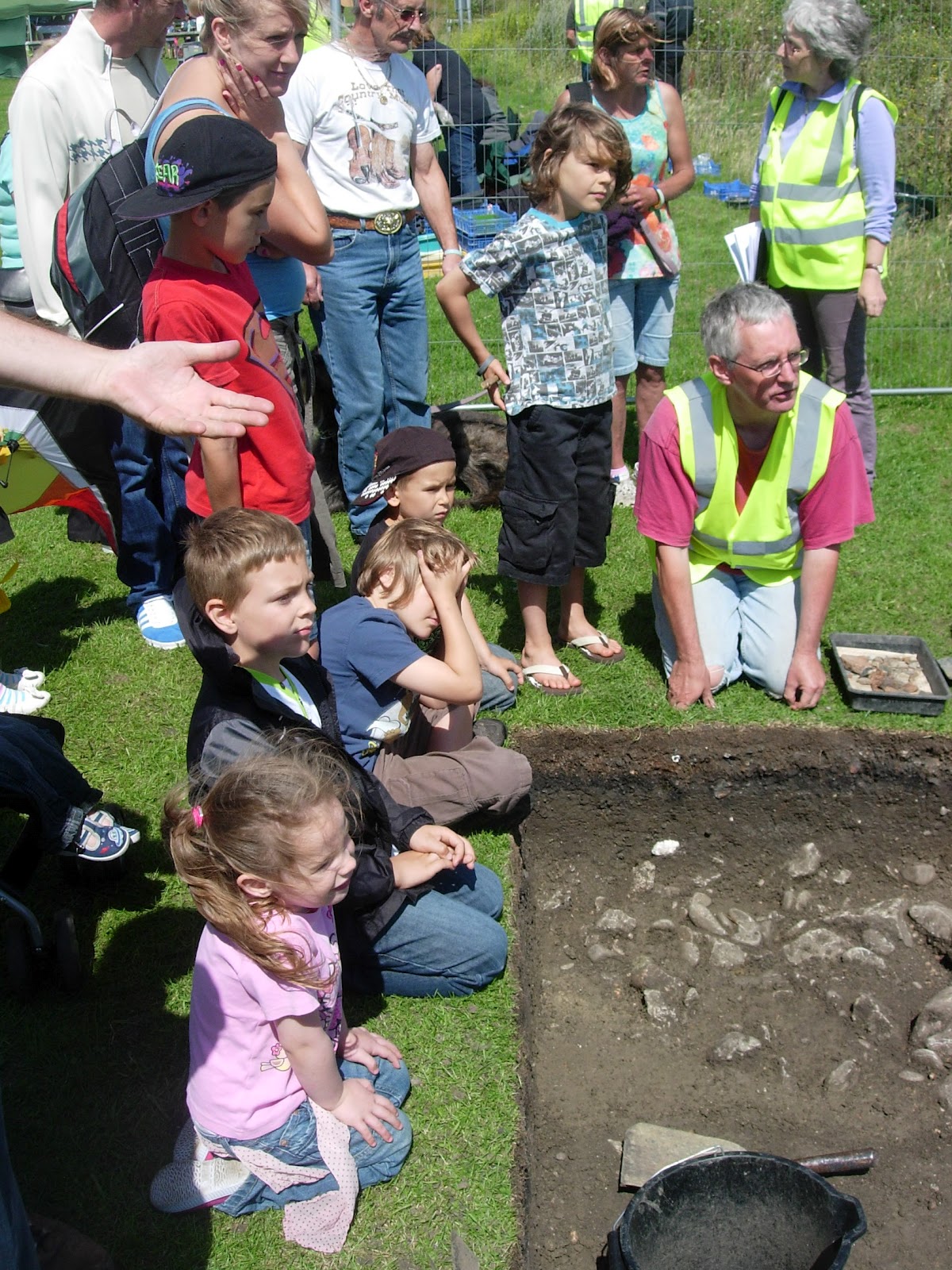
Although there were some young residents of the garden who were fascinated none-the-less...


...even if our best efforts couldn't produce a fully armoured and armed Roman Centurion. All we found was a disappointing plank of wood that looked suspiciously like a scaffolding plank...


...and it was obvious to us the garden had been built up, probably during the construction of the house, and we couldn't go deeper than we had due to health and safety requirements. That doesn't mean to say there isn't anything buried underneath the built up ground though.

Our next garden was just as devoid of archaeology. We started off digging up the vegetable patch...


...and found a piece of carpet!..


...but what was more surprising was what was underneath the carpet...


...and that was the remains of a pet dog! It's in the edge of the section and I have decided to leave it in peace. Other than that the trench was very similar to the previous one with built up ground full of modern detritus.

Never mind, we have more on the way!


...to be continued...


Wednesday, August 8, 2012

Is it a wall? Is it a ditch?? No! It's a.......

NB: Still sorry for the strange picture sizes. Still unsure what's going on.

The weekend was spent at our A Town Unearthed Anglo-Saxon re-enactment weekend with Regia Anglorum and we were also undertaking an archaeological investigation over a suspiciously corner-like feature on Jock's Pitch (the field adjacent to the Villa site). If you ask any archaeologist about the field they say 'Of course there's something there! It's right next to the Villa' but up until last weekend nothing had ever been excavated and surveying results had been inconclusive. We were expecting something, but as ever in archaeology you must learn to expect the unexpected!

So we start as ever by stripping the turf and putting the all important sign up....


.....and then stones! In archaeology 3 stones in a line is allowed to be called a wall so we start to get excited....


...and get this out. It's a tile which has been trodden on whilst wet by someone wearing studded sandals; which the Romans were famous for wearing...


 ....and as it's the re-enactment weekend we get a lot of visitors and they all get excited too...


....and then we find some Roman glass (sorry for the unprofessional scale but that's all I had to hand)...


...and then we clean our feature up and it looks like this..


...it's a bit too rough and ready for a wall and certainly not much like the corner we were expecting. Someone suggested the foundations for a timber framed building but again it's a bit too rugged for that. We begin to wonder if it's a ditch. And there's only one way to find out what it is and that's to dig it out...


...and we come down onto this...


...larger stones lining a cut. Now these are placed with a bit more care than the layer above and given their general size and placement we decide that what we actually have here is a drain. Now those in the know would call it a French Drain but if you are a bit like me I'd know it as a soak away; something that did drain the water out of the soil but would have been a slow seep not a gush like a sewer or gutter. It's exact use and date are up for discussion but we are going for a later Roman feature as it cut through an earlier demolition layer. This fits in nicely with the history of the Villa as it was abandoned for a spell in the 2nd/3rd century AD and re-inhabited sometime in the later part of the 3rd century AD....

So there you have it our first foray into Jock's Pitch and we have an amazing result, even if it's posed more questions than it answered. We are in discussion about possibly opening up some more pits to try and trace it's course and see if we can determine it's function so watch this space!

And finally we had this half a copper hoop/ring out of the trench and one little boy asked me if we had found a smile....


....to be continued...

Saturday, August 4, 2012

The next property done and dusted!

The next property was a bit different again. We were fortunate to be in a garden which was mostly lawn and larger than the previous places we'd excavated. The owners were more than happy for us to dig as much as we pleased and so we began opening up pits..


...I gained a new assistant supervisor...


...and we enjoyed a break in the sun...


...but we didn't find any archaeological features. We had some layers with Roman and Iron Age pottery, much like in all of the properties along this road but no ditches or pits like before. Although our time at the property ended the owners wanted to continue digging so some of my volunteers went back for a few more days and found this in the back fill of one of the test pits...


...an Iron Age brooch! Very nice. I believe it to be from around the 1st century AD (roughly used around the time of the Roman conquest in 43 AD) and it is made of Bronze. If any one has any more info then please do share in the comment box below.

And that concludes our 4th property. We had a total of 7 pits in the end which I think is a new record for the A Town Unearthed project!


...to be continued...

Sunday, July 29, 2012

..and yet another unexpected discovery..

Note: I apologise for the size of some of the photos, for some reason it won't let me make them larger, I will continue to play but for now they have to remain small.

This week we've braved the blazing sunshine and oppressive heat to continue with our third keyhole. We returned to the property we did the first keyhole in to excavate the foundations for a garden wall, but this time in the back garden. Work had been done here previously in 2011 so we knew there may be something of interest and indeed there was!

As usual we start by preparing the site...


...and begin to trowel...


....having an occasional break to take in the view...


.....but it all seems a bit natural...


....until we come across this ditch feature...


.....and start to excavate it, coming across this suspiciously human looking leg...


...and further investigation confirms our suspicions...


...so we record it while we await the burial licence to come through so we can lift it...


..so there we have it, a pair of legs in a ditch underneath someones garden. 

Yes it is more common than you think.

They look broken at the top but that is post-depositional (happened after burial) and do not indicate trauma.

I'm sure you are all wondering how, where, what, why so I'll give you my thoughts on the matter. In the Iron Age (or the time there abouts) it seems that the standard practise of disposing of dead people of lower ranks was in ditches or pits. The Iron Age people who lived in Britain loved their ditches and digging them then filling them with rubbish (which did include people!) seemed to be something of a national past time. That's not to say graves and even cemeteries are not unheard of but the evidence currently points to the majority of the population being buried in this fashion.

We still have some important questions to consider:

Did the body go in whole? Possibly. Again it's not unheard of in this period to find bits of people rather than a whole skeleton raising questions over how people were treated after death. Some believe that the body was allowed to decompose in the open air before being interred (we generally refer to these as 'Sky burials' and was used in the British Isles during prehistory; it was also used by the Native Americans and is still practised in Tibet today). Maybe the legs were separated from the rest of the body, perhaps through amputation or warfare? Unlikely as there seems to be no obvious trauma to the legs ie. no blade/saw marks which you'd get if they had been hacked off. Maybe the answer lies in the present day and I believe, if there indeed was an upper body, then when the ground was levelled at the back of the house then it was probably removed then; the legs have been protected by the slope which you can see in the photo above. Anything is possible!

What happens to it once lifted? All human remains require a licence from the Home Office to lift; it is illegal to remove skeletons without the licence. Now it's out of the ground it will go to be washed and analysed by our lovely osteologist (human bone specialist) at CAT and she'll see if there is anything of note. After that the bones will either be stored at the Folkestone People's History Centre or, hopefully, at the new museum which we hope will be with us very soon! Otherwise the bones will be re-buried in a suitable location (they can not return to the property and do not belong to the owners of the house).

So there you have it. Another exciting test pit discovery. I'll keep you posted on the results from processing.

Any questions or theories please do share.


...to be continued...

Thursday, July 19, 2012

A surprising find in an unlikely location

Hello everyone. Sorry for the silence over the past week, I had a small accident with my laptop on my birthday (after too many cocktails) and broke the screen but we're all fixed now! The last week has been a bit mad, despite the weather, with my A Town Unearthed test pits continuing and spending a couple of days getting eaten by mosquito's at the Randell Manor excavation with Kent County Council. I'm returning on Saturday with the Canterbury Young Archaeologist Club so will update you all then, in the mean time they have a Facebook page which is updated regularly; remember you don't have to be signed up for Facebook to access the page!

Whilst we were doing our first test pit the residents of the house two doors down came over and expressed an interest in having us come and destroy their back garden. I went for a quick site visit and found that the garden was on a slope and had been terraced (terraced gardens usually don't bode well for archaeology) but I decided we'd have a look because of it's proximity to the Martello Tower and the Roman Villa. I wasn't really expecting to find anything which is why what happened next came as a complete surprise!

We started by cutting the turf...


...and get stuck in with the digging...


 ...and come down onto the top of these stones. Now I know they look like they might be in an arc and something deeply exciting, maybe even structural, but unfortunately not. If you look again you will see in the right hand side there is a lot of bone mixed in with the stones, there was also a lot of pot, and the stones are laid too hap-hazard to support any weight; definitely not structural. To me this was smelling suspiciously like a fill of a pit or a ditch (when I say fill I mean the stuff that has washed back or been placed into a hole in the ground after it's been cut). It would explain why the stones are jumbled up and why there was pot and bone all mixed in with it. There's only one way to find out what's going on and that's to get it out!....

  
...unfortunately the weather had other ideas and we had to beat a hasty retreat...


...we get back to it on the next day and my suspicions are confirmed when we start coming getting things like this out of the soil...


....in the top picture we have a collection of animal bone (the big jaw probably comes off a cow). Most of these bones have been broken up or shattered to get to the nutritious marrow which was common practise in the past. There is a piece of pottery in there too which has been dated to the Roman period. The pottery above is probably from the Late Iron Age but a good clean up will tell us for sure. We had a lot of sizable pieces of pottery from the Late Iron Age/Roman period which is fantastic news for our project! Back to the digging, if we have fill material then that means we have a ditch or a pit and we need to establish which it is...


...it starts to get a bit deep and awkward to work in, luckily we have a bright young work experience student to get down in the hole!...


...and we finally reach the bottom of the feature (sorry the photo is a bit rubbish). It is in fact a ditch or a gully and you can see it running across the left side of the photo. We didn't have time to excavate the whole thing but we have established what it is, what the date is and which way it's running. The property owners were very supportive of us so I would like to thank them for their patience and understanding when a 2 day test pit turned into a 5 day excavation!

We are returning to Folkestone next week so will keep you posted on all our developments.

...to be continued....

Monday, July 9, 2012

The first test pit...

Last week we started, and finished, our first test pit with the A Town Unearthed project. I had a fantastic team of volunteers who did a marvellous job, even if the results were not as exciting as last year. This was my first excavation where I was in sole charge of the archaeology and the people but we all survived and I think everything was recorded properly (!)

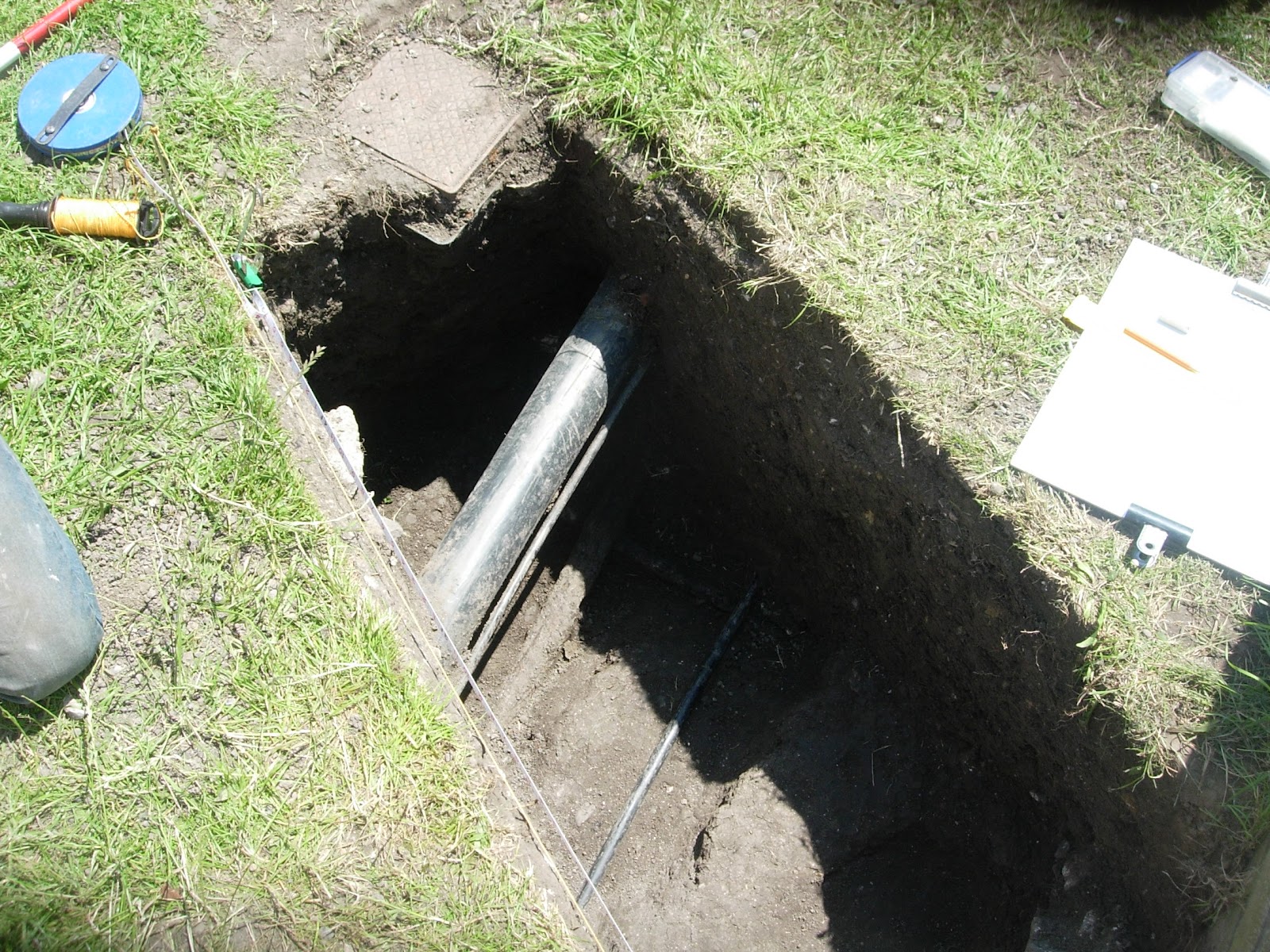
So down the excavation side of things. We were asked by the chap who is doing up the house to come in and dig a water pipe trench from his house to the meter (the trench was about 9 metres long in the end) as he didn't need planning permission for it and thought we might like to have a look. There had been work done on the house before when the walls were put up so we had a pretty good idea of what to expect, and it didn't disappoint.

We start by plotting the trench edge with string and get down to cutting the turf off...

.....we then get to the trowelling....


....with a bit of metal detecting in between breaks for good measure (some archaeologists hate metal detectors/metal detectorists but I don't mind them being used on site)...


...and they come up with a bullet; I have been informed it's from around 1941. We also turned up some military buttons (Folkestone was a very important place in the First and Second World War so finding this sort of stuff is very exciting for me) and two Roman coins...


.....we carry on...


....through a very exciting lovely green clay, which turned out to be a recent dumping episode, you could almost see the wheelbarrow treads...


....


....and eventually find what we were looking for, even if it isn't all that exciting archaeologically...


...and we get down to recording our findings (if you volunteer on my sites I will insist on you having a go at scaled drawings and paperwork; archaeology isn't all about digging!)...


....and there you have it, our first test pit over and done with.

Archaeologically speaking there were no features found because the lawn has been raised over the years so much of the ground is built up. However, the soil probably came from the back garden and the foundations for the house and in it there was a lot of Iron Age and Roman pottery, along with the aforementioned Roman coins.

All in all not a bad start to our season and we have more planned for the coming weeks so fingers crossed!


...to be continued... 

Tuesday, July 3, 2012

The Big French Boat Launch

I'm not going to do a big blow-by-blow account of the launch but it was very nice; there was a lot of champagne and the canapes were very tasty too! We arrived a bit later than planned because we got stuck in the shuttle tunnel (the light's kept going off, it was very nerve wracking!) but we got there in the end. I'm going to just let my photos do the talking (some of them are a bit blurry sorry)..


The boat is suspended on a frame and is tilted to look like it's on the sea, meaning you can see inside the boat at all the packing moss and the stitches etc. The boat is a half scale replica, as are the paddles, which is why they look very small but in actual fact remind you that this boat was much bigger.

You can see from some of the pictures that the exhibition space is in what would have been the Great Hall of the castle. You may be able to spot blocked up doorways and fireplaces as well as the Minstrels Gallery.

The exhibition also includes some fab Bronze Age finds from France, Belgium and Britain like these torcs from a hoard found in Kent...


...but I won't give too much away. The whole exhibition will move from Boulogne to Belguim at the end of this year and then be back in the UK at Dover from the middle of next year so please try and see it!


...to be continued...