Monday, December 3, 2012

The Helmet

Sometimes in archaeology something will happen which is totally and completely unexpected. Sometimes it will be a discovery of a new site which has been lost for hundreds, possibly thousands of years, sometimes a site which was 'not supposed to have anything in' turns up an Anglo-Saxon cemetery (CSI: Sittingbourne reference here), or a metal detectorist will bring something in for identifying.

The Discovery

A metal detectorist got in contact with our Finds Manager, Andrew Richardson, and mentioned that he had found a 'Celtic' helmet in a field he'd been detecting (I would never use the word Celtic - explained very eloquently here by a fellow archaeologist blogger from Archaeosoup Productions). Andrew used to be the Finds Liaison Officer (FLO) for Kent and so knew a lot of the local detectorists through his work. A Finds Liaison Officer works in an area, for Kent they are based at Kent County Council, and are there to record any finds members of the public may bring in, or want identifying by working with the Portable Antiquities Scheme (PAS) to record artefact's and declare treasure. It is an entirely voluntary scheme - unless you do have treasure which must legally be declared - but the information recorded helps archaeologists build up a bigger picture of the history and archaeology of a place.

Andrew went to look at the helmet, being a bit sceptical about the whole thing saying “when I got the phone call saying an Iron Age helmet had been found, I have to admit I was a bit doubtful. Such finds are extremely rare and no Iron Age helmet has been found in Kent before. But the finder is an experienced detectorist and seemed very sure about what he’d found, so I agreed to visit him first thing the following morning. I was delighted when it turned out that he was right!”  

Here's a photo!! The hole in the top was caused by the helmet being upside down in the ground and has corroded over time. The helmet would have been worn with the 'peak' at the back.

Images courtesy of CAT
....He also found this lovely brooch and spike (which we believe went on top of the helmet possibly to hold a plume).....

Image courtesy of CAT

.....but suggested that there may be more in the area as he had got further readings with his detector but didn't have the time to explore them. He had tried to get hold of the farmer, but couldn't, so removed the helmet and took it home with him. He left a bag of lead weights in the hole before recovering it so as to find the spot again if required, which was very good of him because one cold October Saturday some of us (a handful from CAT and the Dover Archaeology Group) went up there to investigate the hole further, to record the find properly, and to see if there was anything else in it. The detectorist had picked up cremated bone so we wanted to have a look at whether this was a burial or not. As you can see by the photo it as not a small field and the fact he came across it at all was more luck than judgement!


We get down to digging and find the hole the helmet came out of....


...which was a little smaller than we were expecting, although in all honesty we didn't know what we were going to find! Tina started excavating the hole with a gang of anxious on-lookers...


...and started to find more cremated bone (being saved in the red pot above)! When questioned the detectorist, who came out too, stated that he had removed the soil out of the helmet when he took it out of the ground, and that the bone had come out then. We were all hoping that this was the case, as no one present could think of a parallel 'helmet burial' in the UK and we could test our theory out by excavating the undisturbed fill (back fill) of the original cut (hole dug to put the helmet in) which had remained undisturbed when the detectorist had removed the helmet. Make sense?

We carried on and came across this. This is the impression of where the helmet had been in the ground and you can see where the copper in the bronze has stained the surrounding soil, and if you look very closely you can see the remains of the top of the helmet on the bottom. This for us is very exciting as we can now record the exact position, alignment, depth and location, and we like doing that in archaeology.


The next step would be to remove the rest of the undisturbed fill. We want to see if there is any more cremated bone or any other datable material, like pottery, to help us in our interpretation. My next photo shows another feature we picked up on and that is plough furrows. These are the vertical marks in the photo cut into the natural geology and are caused by ploughing over many years, especially with the advent of better machines which can plough deeper into the soil.


The helmet itself has been dinged (technical term) by the plough and has caused some damage to the front. It was fortunate that the helmet hadn't been dragged down the field or suffered extensive damage from the plough, like the Ringlemere Cup which had unfortunately been partially crushed when that was found in 2001.

Luckily on further excavation of the hole we found no more bone in the soil which is great for us as it means the cremation was placed in the helmet at the time of burial. The brooch, we think, was used to secure a bag made of leather or cloth which would have held the cremation before it was placed in the upturned helmet and put in the ground.

So what does it all mean?

Only 3 other helmets from this period have been found in the UK and none of them are like this; the Horned Helmet found in the Thames at Waterloo, one from near Bogner Regis, and one from Snettisham in Norfolk. As far as we are aware there are no other 'helmet burials' found so far in the UK from this period, and the only other that we know of is from Poland, so we are all excited about it's discovery!

What we do know is the helmet is unlikely to have been made in the UK and possibly came over from Gaul. It is tempting to place the helmet in the context of Caesar’s Gallic War, or his expeditions to Kent in 55 and 54 BC. However, it is of a type which could have been used by Caesar’s troops, or their indigenous allies and enemies making the identification of the individual inside very difficult. There are many ways such a helmet could have come into the possession of a member of the local Cantiaci tribe, rather than representing a Roman military burial in the field. Mercenaries from Britain had travelled to join the fighting in Gaul, and it is possible that this helmet could have belonged to a British or Gallic warrior who fought in Gaul, against the Romans or perhaps even alongside them, eventually bringing the helmet back to Britain with him. Of course the person inside may not even be the person who wore the helmet in life, and until the cremation is analysed properly we can't rule out that it may not even be a man inside it......

What happens now?

As you can see there are many questions left to be answered.

If the helmet had been discovered on it's own it would not have classed as Treasure but luckily for us it came with a very nice brooch and under the Treasure Act 2003 two, or more, pieces of pre-historic metalwork are considered Treasure. As such we have had to declare it and we have taken it to the launch of the Annual Treasure Report at the British Museum. This is a annual event where the more exceptional items of Treasure will be put on display for the Press to see and, hopefully, publish in their newspapers.

For the time being the helmet, brooch and cremation will remain at the British Museum. The cremation and helmet will be analysed by specialists and conserved. Once the  Treasure Valuation Committee have valued it, it will be offered to the local museum in Canterbury and if they can't afford it (lord knows what the value might be) then the British Museum may be able to raise the money to keep it. Otherwise it might go into a private auction, like the Crosby Garrett helmet found in 2010. 

So for now that is all I can really say on the matter. I will keep you all posted with further developments!!


...to be continued....


Monday, November 26, 2012

The Sanatorium

*Sorry for the small size of some of the maps, for some reason I can't make them bigger (I've had this problem before with Blogger), will keep playing!)

I went on a few posts back on finding out more information on the Sanatorium that used to be on the East Cliff in Folkestone and is now currently a school. I did some excavation work with the pupils of the school to see if we could find any evidence for it, which we did in the form of bits of building debris and domestic rubbish.

So far I have been in contact with two lovely people who are very passionate about the history of Folkestone, one is Alan Taylor, who is part of Folkestone and District Local History Society, and Christine Warren, who runs the Folkestone Then & Now website. If you ever need a question answered about the history of Folkestone then go to them as they are a mine of information! I also need to thank my volunteer Mike who lived in Folkestone in his youth, and is not just another mine of information, but has helped me amass whatever information we can on the site.

It appears, however, there is not much information out there on the Sanatorium which is a shame. Alan sent me some photos of the East Cliff Sanatorium which I shall use in my story but some of the the gaps will be filled with my own family history surrounding Sanatoriums. My (paternal) Grandmother spent a year in one outside Newport, Wales, in the 1930s and she had her 7th birthday there. Although she is in her mid-eighties, remembers it vividly and some of my story will draw on the information she gave me about her time there. She has also told me about the time my (paternal) Grandfather spent in one in Herefordshire for Rubella at roughly the same time, and her Mother (my great-grandmother) was in and out of them all her life with an unknown chest compliant (possibly from contracting tuberculosis as a child).

Sanatorium's were run like hospitals and provided a clean, sterile environment with professional care for those who were suffering from long term illnesses or infectious diseases. Houses at the time were not subjected to the cleaning products we know and love today, and food could be scarce or unaffordable making balanced healthy diets unobtainable for most households. In the Sanatorium the patient was well fed (probably better fed then they would have been at home), children went to school in the compound (often outdoors to maximise the intake of fresh air), they were taken on walks to benefit from the fresh air, and the whole experience was generally pleasant. In Folkestone the council decided to erect the East Cliff Sanatorium on 18th February 1871. At the time it was believed that many infectious diseases and medical conditions could be cured or improved by 'taking in the sea air' or going sea bathing. Folkestone was one of the more popular sea side resorts, and remained so until the popularistation of air travel and cheap holidays abroad, and had many hospitals, sanatoriums, and medical clinics where people could get better and enjoy themselves at the same time!

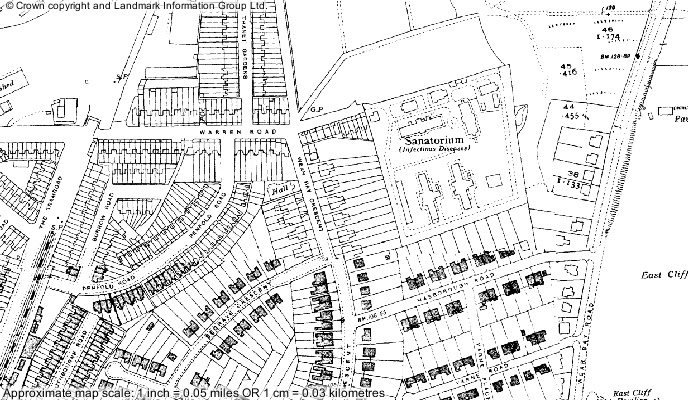
A map (taken from Kent County Council Historic Environment Record; do go and have a play with it!) dated 1897-1900 shows the hospital at the end of Warren Road.


You'll also notice to the right of the map, near the train tracks, they have written that Roman remains have been found! These are now completely covered by roads and houses but we believe they may be associated with the Villa (I will do a post on the Villa site in the next few weeks). Kelly's Directory in 1913 (like our modern day Yellow Pages) states...

'...The Sanatorium for Infectious Diseases (smallpox excepted), erected in 1877, at a cost of about £2000, on the East Cliff, contains 10 wards, with 41 beds and 16 cots and detached offices. New wards for typhoid and diphtheria, administrative blocks, and a mortuary and laundry were erected in 1898 at a cost exceeding £6000, and 12 additional beds provided. There is also a small pox hospital, built under the hills about a mile from the town and containing 12 beds...'

...so there was enough demand for the facility to expand the site in 1898. I don't have any photos for the early phase of the Hospital so we'll move to the next map which is dated 1907-1923.


You can see the houses beginning to creep towards the Sanatorium as the town expands towards the sea. We have some photos from this period, and these are explained below. At this time it was often referred to as The St Mary Magdalene Home for Children. St Bernardo's Children's Home was on Wear Bay Cresent not far from this site.


This is the site in 1915 during the construction of new military wings of the Sanatorium. I believe that it is Martello Tower 2 in the background, now a holiday let. During the First World War Folkestone, along with Dover, played a huge part as they are very close to the French coast; so close that people in the town could hear and see bombs going off in France! Folkestone was the main port that shipped troops out to the frontline, Step Short is a local society set up to honor and remember these people, and for more information do look at their website. In 1917 Folkestone was subjected to one of the first German aeroplane bombings when bad weather forced the planes, which were heading to London, to turn back and they dropped the bombs over the town; one landed in the middle of a busy street killing many women and children who had been queuing for groceries, and amongst others one was dropped on the East Cliff area by Martello Tower 3. Although the Sanatorium didn't suffer a direct hit the blast from the bomb by Martello 3 was enough to blow the windows out of the buildings.

Folkestone became a place for injured soldiers to recover. It had a large number of hospitals and sanatoriums which were easily adapted or expanded to accommodate the patients and our sanatorium was no exception. The Sanatorium my Grandfather was a patient in was adapted in the same way, although when they began to take in soldiers they stopped taking other patients, and when the soldiers left the building was closed as a hospital. Here is another photo of the military blocks going up, the buildings in the background are along Wear Bay Crescent and still exist today!


So we leave the First World War behind and move onto the Second World War. Here's another map dated 1929-1952. The Sanatorium is now almost completely surrounded by houses and the development continued along the East Cliff until quite recently. During the War the buildings were directly hit by a bomb in July 1940, I don't know whether anyone was hurt in the incident but air raid shelters and other prevention methods were in place so I'd like to hope not.


The Sanatorium looked like this.....


...and as you may notice is called The Borough Sanatorium. I'm not sure why they changed the name, it may have something to do with the military using it, maybe it didn't accept children once they had moved in, or perhaps the local authority purchased the hospital. The large building in the middle of the photo, facing towards us, is the original Victorian block. The brick building to the right, that looks like a house, is probably part of the administrative buildings added in 1898, and the two nearest us are likely to be the military blocks added in 1915. I am reliably informed by Mike that 'The Borough Weather Station' was moved to The Lees as he used to use it in the late 1950s as a young lad. One final picture from this period is below.


It shows the nurses being given gas mask training in 1938 by H. W. Gill.

My final photo comes from the 1950s. You can see the houses creeping along the road, in less than 20 years all the allotment gardens had been built over.


You can see they have removed the military blocks. Many were pre-fabricated structures only intended to be temporary so their removal is not surprising.

The Sanatorium was demolished in the late 1960s. The World Wars had advanced medical science and the advent of antibiotics and inoculations made many of the diseases that had affected the patients treatable, or non-existent in some cases! Many Sanatoriums became redundant and were either turned into medical wards, residential properties, or demolished altogether.

Today St Mary's CE Primary School occupies the site (see the connection in the name?) and I hope to be able to give all this information to them so they may use it in their lessons, and build upon it in the future!


...to be continued....

Thursday, November 15, 2012

Community Archaeology: Is there a right way?

I've been 'doing' Community Archaeology now for over 6 months and have been exposed to the many different ways in which go about it. I've also been doing some reading on the subject and thought it was high time I shared my thoughts and observations with the world. (I'm centering this on excavation work, not on all aspects of community archaeology). 

Here goes..

Community Archaeology is not a recent thing and has been a recognisable element of archaeology since the outset; it is arguably how interest in what we now define as archaeology started. The introduction of PPG-16 in the 1990s banished community involvement from the majority of archaeological works, with the exception of a few minority projects but these were few and far between, and predominantly in areas where Archaeological Trusts were operating. Community involvement in archaeology has increased over the past 10 or so years and now these sorts of projects are common place all over the UK as more and more funding and resources have become available to instigate them.

As a result attempts have been made to define community archaeology, to give it a methodological framework which can be applied to projects, to come to terms with how community archaeology fits into the discipline as a whole, and if the archaeological record produced from these projects is 'good enough' to be relevant to the professions. I shall do a post in the future on the frameworks that are being developed otherwise we'll end up with an enormous rambling post! Anyway, today I'm going to discuss two different 'types' of project that have been identified in 'Archaeology from Below' by N. Faulkner in Public Archaeology 1:1 (2000):

 Archaeology from Above - A Town Unearthed

These sorts of projects are created and run by external professional organisations, not necessarily archaeological and not necessarily a single body. The community is not excluded from the planning process and have representatives present in project meetings so their views are presented and considered, but ultimately all the planning and the undertaking of the project is controlled by external bodies.

A Town Unearthed is an example of this approach. The project is managed by a number of organisations - Canterbury Archaeological Trust, Canterbury Christchurch University, and Folkestone People's History Centre - who set the project aims, organise the paperwork and resources, and do all the administration. Volunteers are included and involved in all aspects of the project, from administration, education and outreach work, archaeological work, stewarding events, press releases, etc. They are represented at meetings, their ideas are listened to and taken on board, and any skills they have, and offer, are gratefully received. However all responsibility for publications, meeting project targets, budget control and timescale are dictated by the managing bodies.

Archaeology from Below - Northfleet Harbour Restoration Trust

As Archaeology from Above is instigated by 'professional' organisations these sorts of projects are set up and run by community groups who have contact with professional organisations, but run and manage their own projects. Training and guidance can be provided by a professional archaeologist but control remains with the community.

The project at Northfleet is set up in this manner. The volunteers have produced their own research aims, they have assembled the correct documents (insurance, permissions, risk assessments), they secure their own funding, they will excavate, process and store all the material, and ultimately they will write their own reports. My role in this is to provide training to them on excavation and recording techniques, and then on how to process and store their finds correctly, and finally to provide guidance on the final report. All responsibility for the project is with the community who may call on professionals for advice, but ultimately have full control over the project.

Which is the right way?

I don't personally believe there is a right way of 'doing' community archaeology. There are some archaeologists, and communities, who believe the Archaeology from Above is not proper community archaeology as it has not been instigated by the community. That having projects set up and run by professional archaeologists serves only our own aims and objectives, regardless of what the community might think. While I can see the argument here I can not dismiss this type of community archaeology. Not all volunteers want to, or can, dedicate that much time to setting up and running a project on a large scale; many are enjoying their retirement and don't want to be launching themselves into large-scale projects, some volunteer for other organisations, and some look after children, grandchildren or relatives. Not everyone in the community is even aware of the existence of their local archaeology, for example the location of the Villa site at Folkestone was not widely regarded as common knowledge, and are therefore not aware of the danger it might be in from damage or destruction.  And while it may seem to serve our own objectives, and some may argue our egos, the knowledge gained from investigating the sites benefit everyone, not just ourselves.

Archaeology from Below works but a few important considerations must be taken on board by the community starting this sort of project. I would hope that if they were to think of undertaking excavation they would recognise that it is a destructive process and if not recorded properly then that information is lost to all of us. In archaeology there has been an attempt to standardise the recording process, and although there is a degree of flexibility in how and what is recorded community groups should be aware of the procedure. Whilst I am more than happy for non-professionals to undertake archaeological work I would expect them to be recording the archaeology in a similar manner to professional units; although some professionals often leave much to be desired in their paperwork! Also archaeology is not about 'digging stuff up' there has to be a purpose to the digging and a proper interpretations must be developed after the excavation is over otherwise the exercise is pointless. 


So there we have it two different types of community project. Each works as well as the other, in my opinion but not everyone agrees. I also believe that as long as archaeologists are going out there and setting these projects up, or providing help to those who have, and therefore engaging the community, does it really matter? Community archaeology is hard to define as it comes in may different forms so needs flexibility not stringent structure. My concern is that we can get so bogged down in methodology and 'ticking the right boxes' that we can forget why we started doing this in the first place, and that would be detrimental to both the professional archaeologists and the communities we work for.


References and Further Reading (a bit limited at the moment but I am hoping to expand on it soon!)

  • Faulkner, N. (2002) 'Archaeology from Below'. Public Archaeology 1:1. Pages 21-33.
  • McManamon, F. (2000). 'Archaeological Messages and Messengers'. Public Archaeology Volume 1:1. 
  • McManamon, F. (2007) 'The Importance of Archaeological Interpretation and Multiple Points of View'. Interpreting the Past Volume 2.
  • Simpson, F. and Howard, W. (2008) 'Evaluating Community Archaeology in the UK'. Public Archaeology, Volume 7:2. Pages 69-90.
  • Tully, G. (2007). 'Community Archaeology: general methods and standards of practice'. Public Archaeology Volume 6:3.


...to be continued....

Wednesday, November 7, 2012

The End of A Town Unearthed!

I finally finished my last test pit in Folkestone! As much as I've loved this project I am pleased that we've wrapped up the excavation side of things, not just because the weather is now turning chilly but I have long neglected other projects which I am excited to be getting back to. I will be doing bits and bobs but no further excavation.

However, we now progress to the next step in the archaeological process which is finds processing, data entry, analysis and writing the report. We take all the information gathered on site - our context sheets (which have of course been filled in!), our photographs, our finds (all washed, weighed and analysed), our drawings and sketches, and any other information we might have gathered - and we then write our interpretations based on the evidence we've gathered over the excavation season. This is the first time I've written a report. I've seen them but have never written one. Report writing is generally given to senior/supervisory staff, who may not have even been out to the site they are writing the report on, and to be let loose with one is a great step forward in my career.

I am to write up all of the test pits dug during the A Town Unearthed project. There were 3 done in 2009 in the east Cliff area, 5 done in 2011 on The Bayle and then my test pits which finished a couple of weeks ago. I was concerned that my record keeping would not be up to scratch but looking back over the records kept of the past test pits I didn't need to have been! Please don't misread my comments and criticisms as applying to any person, or group of people, but in archaeology you do sometimes get sparse record keeping - maybe there were time pressures (very common), the weather might have been too poor to fill the sheets in outside - and people forget to go back to up date the records. As not all archaeological sites are written up immediately after the excavation finishes it may be months or even years before the gaps are discovered but by then it's too late, people have forgotten and the archaeology has been destroyed.

Luckily for me there were aspects of the records, like a scaled drawing on one pit and a filled in context sheet on another, so was able to spend some time piecing together the missing gaps from the photo record and am now in a position to begin writing the report!

I'll keep you all posted, although it's not the most exciting thing happening.

And before I forget, we made it to the papers with our work with the school!:


...to be continued...

Monday, October 22, 2012

6 month review

I had my 6 month review back at the start of the month, seems like only yesterday I started! It's all going very quick.

You all know the sorts of things that I have been up to over the past 6 months and there are plenty more adventures to be had before the end! Once the outside work at Folkestone is completely over (maybe by the start of November) I'll be moving on to the next excavation project which I can't mention yet as nothing is set in stone, but be rest assured I will update as soon as possible! I do really need to crack on with gathering my NVQ material and looking at the gaps. I'm still very confused about it, it doesn't make any sense to me! I seem to be getting the wrong end of the stick when it comes to what classes as suitable evidence for the module points but I'm sure we'll get there in the end.

As far as community archaeology goes I am really enjoying the experience and feel this is something I might, hopefully, remain in or at least a part of during my archaeological career. Although a little early to predict but it seems very unlikely that I will be able to remain with the Trust at the end of my placement, however, it is all early days yet and we are working hard on a project which might keep me in employment. Some people have asked if I will stay in archaeology if there are no community-based jobs and the answer is of course! I'm not naive, I'm happy to do anything archaeology related just as long as I have a job and can stay doing what I love! I can always keep an eye out, or maybe even set my own project up!

All in all the placement has gone very well so far. I hope all of us placements get an opportunity to get together before the end as we haven't had much contact with each other, though it is a little tricky given that most are in Wales and there is at least one in Scotland. I am trying to gain a little bit of experience in everything to do with archaeology so my CV looks nice and tasty should the worst happen next year; luckily I have some very supportive colleagues and I'm getting to do all sorts of things I wouldn't normally get the chance to do.


....to be continued....

Sunday, October 14, 2012

...so we finally get to digging

We've had some nice days over the past few weeks so we've started at the school....


...this is me giving the first group their health and safety talk...


...and we get kitted up....


...then down to the serious business of digging....


....and here are the sorts of things we've found so far, not so exciting archaeologically but the pupils have been very pleased with their discoveries, especially this one..


...an old metal lock plate including doorknob and key!

We'll be going back over the next few weeks so we'll see how many other treasures we can uncover...


...to be continued...

Wednesday, October 3, 2012

..and then it rained.

All my best laid plans to go excavating with the Primary School were cancelled last week as the rain set in. A lot of you must be thinking that as an archaeologist I shouldn't mind digging in all sorts of weather conditions, and I don't (oh the stories I could tell), but I can't expect young children to be out there in it with me and that was the point of going there in the first place. So we've postponed it until this week when the weather *should* be a little better.

That means I've had a week in the office sorting out everything else that I should have been doing over the last few months. I think people have a massive misconception of what happens in an archaeological office; maybe there will be exciting finds lying around, maybe a skeleton here or there, maybe we'll be all gathered round - like in History Cold Case - debating a site we've been working on or an interesting feature we've got, or maybe we're just throwing Anglo-Saxon gold at each other. It doesn't happen (well maybe the skeleton part does) and most offices work like normal offices where people are swearing at computers, stressing about budgets, drinking loads of tea, and moaning about the weather.

Anyway here's a quick round up of my office-based week:

 NVQ
Still going through that. I've got my line manager and placement mentor helping me decide what the syllabus points are asking of me. I had a meeting with my NVQ assessor on Monday so I'm putting stuff together as of now to build up my portfolio.


Databasing for the Test Pits
Excavating produces a lot of paperwork. It's a destructive process, we destroy the archaeology by removing it, so detailed records must be kept so the information can be analysed in the office or by someone else at a later date. After finishing the excavation the archaeologist (or someone sat near a computer) puts the information written on the sheets done on site (which it's why it's important these are filled in!) onto a database for ease of access and retrieval. It can be hugely time consuming and data bases vary from unit to unit, but is an important part of the site record so must be done.

It's taken me a couple of days to put the A Town Unearthed stuff on so far. I've never used the system CAT uses and it's taken me a while to get my head round it. The system they use (called the Integrated Archaeological Data Base) is very detailed and you can link up site photos, plans, context sheets OS grid points, finished reports, finds analysis, environmental results etc to the one place so, in theory, if you wanted any information on that site all you had to do was open the file up. It just takes a long time to link everything up, and my computer is slow too so that doesn't help! 

Meetings for projects I can't talk about yet
There are a lot of future archaeological projects planned for the Canterbury/Kent area which I will be involved in over the next few months. I'm not allowed to publicise the projects or even really talk about them to anyone because they might not go ahead; a lot of them are dependant on finding funding and we don't want to be getting peoples hopes up on something which may not happen. Anyway, Kent should be a very interesting place to be if you are in to archaeology in the next few years.


Parks for People
I've been to a few meetings on the project, which is still in fairly early stages so I, again, can't really talk about it. There's a website to look at which has information on the project.

The results for our Folkestone skeleton came back
And as suspected there was nothing wrong with the surviving bones. Here's a photo:


When buried skeletons can have a bit of a rough ride before we find them, if we find them, so to find just a pair of legs is not too uncommon.You may have noticed that some of the toes are missing and, again, this is quite common and does not mean they were missing whilst this person was alive. This can be put down to a (not exhaustive) list of factors; for example, sometimes the small bones are missed by excavators if the soil is particularly sticky or wet, sometimes the bone degrades quicker than the rest of the skeleton, and sometimes burrowing animals or worms can move them around. As for the rest of the body it seems that the rest was indeed removed during an earlier phase of work on the house, which is a shame as not a lot can be deducted about an individual from just a pair of legs; rough age (adult - over 20), pathology (none). Anyway, final conclusive interpretations will follow but I will say the owner of these legs did not have any leg-based injury or disease.  

Hopefully the weather gives us a few days of more excavating before the winter properly sets in!

....to be continued....